
TNWG Wine Times: Ep 63: The Country You've Been Overlooking — Slovenia and Its Secret Grapes

There is a country in the heart of Europe, which is one of my absolute favourites to visit — smaller than Wales, squeezed between Italy, Austria, Hungary, and Croatia — that has been making wine continuously for over two thousand years. Its winemakers helped pioneer the modern natural wine movement. Its indigenous grape varieties grow nowhere else on earth. Its amber wines are among the most sought-after bottles in the international fine wine world.
And the vast majority of people who drink wine regularly have never heard of it. Indeed, I have been lucky enough with work to see large parts of the country, the culture, the people and the incredible landscapes.
Slovenia deserves better. So this week, the Wine Times is heading east — or more precisely, slightly south-east — to a country whose wine story is one of the most interesting anywhere on the continent, and whose native grapes are long overdue a moment in the mainstream spotlight.
A country with everything

Part of what makes Slovenia so compelling as a wine nation is its sheer geographical diversity. Three completely distinct wine regions produce wines of radically different character, shaped by Alpine influence in the northeast, continental climate in the east, and Mediterranean warmth along the Adriatic in the west.
The western region, Primorska, is where most of the international attention is currently focused, and with good reason. It encompasses four sub-regions — Goriška Brda, the Vipava Valley, the Karst plateau, and Slovenian Istria — each with its own terroir, its own traditions, and crucially, its own grape varieties. The chalky, layered flysch soils of Brda sit directly on the Italian border, where Slovenian and Italian vineyards are sometimes separated only by a country lane. The iron-rich red terra rossa of the Karst is shared geology with Croatia. The Vipava Valley, sheltered by the Trnovo Forest Plateau, is regularly swept by the fierce bora wind — locally called the burja — which reduces disease pressure dramatically and makes organic farming not just possible but almost the default.
It is also, almost uniquely in the wine world, the exclusive home of grape varieties found nowhere else on the planet.
🍇 Zelen: the grape that almost disappeared 🍇
There are wines that taste like a place, and then there is Zelen — a wine that tastes like the specific hillside it was grown on, and nowhere else.
Indigenous to the Vipava Valley and grown nowhere else on earth, Zelen — the name translates roughly as "green" in Slovenian, a nod to the greenish hue of its straw-coloured wine — was all but extinct after the Second World War. The industrialisation of Yugoslav agriculture prioritised volume over variety, and grapes like Zelen, which offered no obvious commercial advantage, were largely abandoned.
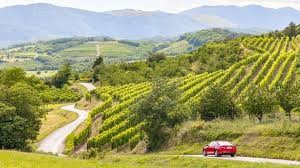
Its recovery is one of the quiet heroic stories of European viticulture. Painstakingly revived by dedicated Vipava Valley winemakers from the 1990s onwards, Zelen is now flourishing — and drinking it is to understand why they bothered. It is a semi-aromatic variety with a rich, distinctive aromatic profile unlike anything else in the wine world: spicy Mediterranean herbs, dried apricot, a mineral freshness, and typically a low alcohol level of around 11% that makes it feel elegant and precise rather than heavy. There is a sweet-sour tension on the palate, a lingering finish, and a complexity that seems improbable for a grape most of the world has never encountered.
It is the kind of wine that makes you put the glass down and think. Which, as I've said before, is exactly the kind of wine worth seeking out.
🍇 Rebula: ancient, amber, and having a moment 🍇
If Zelen is Vipava Valley's best-kept secret, Rebula — known across the border in Italy's Friuli as Ribolla Gialla — is Goriška Brda's calling card, and it is arguably the grape that put Slovenian wine on the international map.
Ancient records place Rebula in the region as far back as 1289. In its conventional form it produces a crisp, aromatic white with citrus and apple character, good acidity, and a faint almond quality on the finish. In the hands of Brda's most celebrated natural winemakers, however, it becomes something else entirely. Extended skin contact — fermenting the juice with the grape skins for days, weeks, or even months — transforms Rebula into a deeply complex amber wine of extraordinary depth: dried apricot, beeswax, orange peel, chamomile, a tannic structure more usually associated with red wine, and a persistence on the palate that can last for minutes.
It was in the cellars around Goriška Brda that the modern amber wine movement — what the wine world sometimes calls "orange wine" — found much of its intellectual and practical foundation. Producers like Movia, operating across the Slovenian-Italian border since the early eighteenth century, became reference points for a generation of natural winemakers globally. The influence of what happened in these hillside cellars can now be felt in wine bars from London to Tokyo.
🍇 Vitovska: the wind-shaped white of the Karst 🍇
Move south from Brda to the limestone plateau of the Karst, and you find a completely different landscape and a completely different wine. The Karst is stark, dramatic, and ancient — a plateau of porous limestone with pockets of that distinctive iron-rich red soil, the terra rossa, that gives its wines an unmistakable mineral backbone.
The signature white grape here is Vitovska, believed to be a natural cross between Prosecco Tondo and Malvasia Bianca. Herbal, lightly aromatic, with a lemon-and-honey character and a saline mineral edge that speaks directly of the limestone beneath the vines, Vitovska is a grape that rewards patience. It is increasingly being made in skin-contact styles by the Karst's small, dedicated group of producers, where it gains texture and depth while retaining its extraordinary freshness. Some producers are also experimenting with it as a base for pétillant naturel — gently sparkling, bottled before fermentation is complete — with results that are quietly thrilling.
🍇 Pinela: the gentle, floral other half 🍇
Zelen's natural companion in the Vipava Valley is Pinela, a variety whose origins remain somewhat mysterious. Its history in the region is long, its documentation patchy. What is less mysterious is what it tastes like: yellowish with greenish hints in the glass, a distinctive varietal bouquet that is gentle, fruity, and floral, with a light elegance and good freshness that makes it one of the most immediately appealing of Slovenia's native grapes.
Pinela is often blended with Zelen and Rebula in the traditional field blends of the Vipava Valley — wines grown from mixed plantings harvested and fermented together, a practice that produces something greater and more complex than any single variety might achieve alone. Increasingly, however, it is also bottled as a varietal, giving wine lovers the chance to understand what it brings to the blend: that floral lift, that delicate fruit, that softness of texture.
Both Zelen and Pinela are, in the truest sense, wines of a specific place. They cannot be grown elsewhere. They cannot be replicated. They are, in a world awash with internationally recognisable varieties, something increasingly rare — a genuinely unique taste that exists only because a small group of winemakers in a small valley in a small country decided it was worth preserving.
Why it matters, and where to start
The broader significance of Slovenia is this: in an era when the wine world is shrinking towards the familiar — towards Sauvignon Blanc, Pinot Grigio, Malbec, Prosecco — it represents everything that is still wonderfully strange and specific about wine. Its indigenous varieties are the embodiment of terroir. They taste like the wind that shaped the valley, the limestone beneath the red soil, the winemaker who decided not to let them disappear.
The UK is a growing market for Slovenian wines, with increasing interest in both traditional and natural styles. They tend to offer excellent quality relative to their price, partly because they remain under the radar of the broader market — but that window will not stay open indefinitely. The natural wine community has known about Brda and the Vipava Valley for years. The mainstream is starting to catch up.
If you want to start exploring, look for Rebula from Brda — either in the crisp conventional style or, if you're feeling adventurous, in an amber wine style from a producer like Movia or Kmetija Štekar. From the Vipava Valley, seek out a Zelen from Batič or Guerila, two producers doing exceptional work with indigenous varieties. And from the Karst, a Vitovska from Štoka is one of the most distinctive glasses of wine you can pour from anywhere in Europe.
Slovenia has been quietly making extraordinary wine for two thousand years. It is, perhaps, finally time to pay attention.
I am also looking for any Slovenian vineyards or winemakers who might like to appear on The Andy and Olly Show - a podcast dedicated to giving vineyards and winemakers a global audience and giving wine enthusiasts more information and insights into wines produced in different regions in the world.
For those who are looking to venture in Slovenia, do give me a shout, I would be more than happy to give you some tips as well as some recommendations for your trip - I cannot recommend the country enough!
Let me know if you explore Slovenia anytime soon!
Best Regards
Andy aka The Northern Wine Guy


Comments